Monday, September 9, 2013

Changing Out the Silica Gel


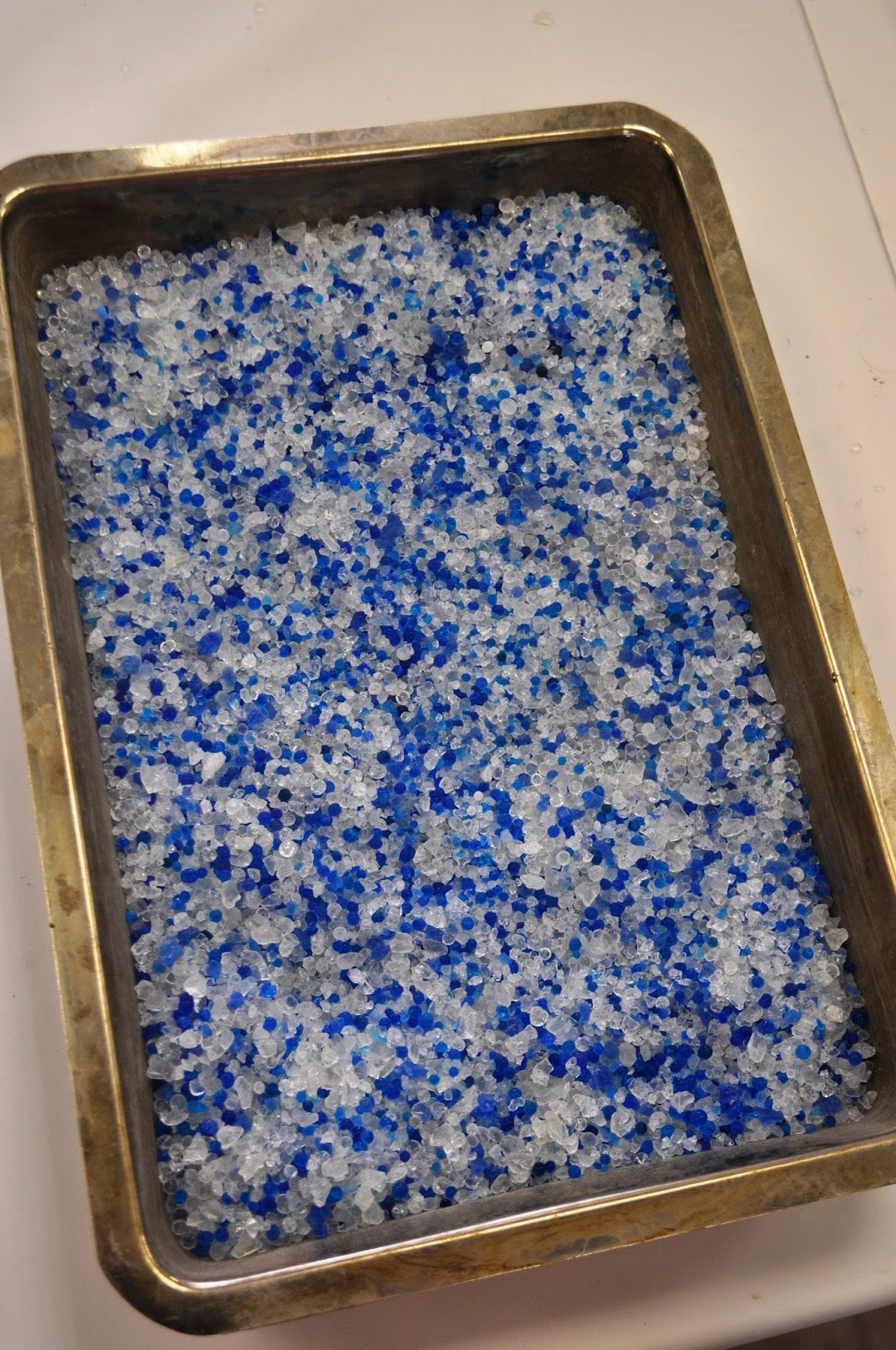
Silica gel is a form of silicon dioxide (SiO2) with an expansive microscopic pore structure that provides a large internal surface area capable of absorbing and desorbing water molecules. It has been widely used as a desiccant for food and other goods since the beginning of the 20th century. Because art objects require a stable environment, the museum world uses silica gel to control the relative humidity (RH) in exhibition cases and in storage. At Kaman Kalehöyük silica gel is used in storage containers to stabilize the RH. The gel is most often used to create a low humidity environment (≤ 30%) for metal objects, because many of the primary deterioration reactions for metals involve water.


An important part of the conservation work at Kaman Kalehöyük is re-conditioning and replacing the silica gel in storage. Some of the granules are doped with a moisture indicator (cobalt(II) chloride) that  gradually changes color from blue to pink when it transitions from the anhydrous  to the hydrated  state.  Pink silica gel is removed from the storage containers and reconditioned in the oven. Once it has returned to the anhydrous (blue) state, the silica gel can be returned to the many storage containers. 

Friday, August 16, 2013

Making Seal Impressions

Over the last few weeks we've been making impressions of seals. At Kaman-Kalehöyük, the types of seals that are usually excavated are flat, disc-shaped impressions with a raised or incised design on clay, stone, or metal. In antiquity, these would have been found on containers or communications to demonstrate that they had not been tampered with before they had reached their destinations.

To make these seal impressions, we've been using Sculpey, which is a brand of polymer clay made by Polyform Products in the United States. It can be easily molded and put into a conventional oven to harden. This will allow us to better understand the surface detail, especially of the seals.


First, we worked the Sculpey until it sufficiently softened. Then, we roll the Sculpey into a ball. We usually do a minimum of two impressions of each. This allows us to get the best possible result from the impression.

Conservation intern Davina is working the Sculpey in preparation of molding.

The balls are then flattened slightly and pressed against the surface from which we want to take the impression. The Sculpey is then peeled away from the surface gently.


We then line the baking tray with aluminium foil and place the Sculpey impressions on the foil. The Sculpey goes into the oven at 135°C for 15 minutes, as per the instructions on the packet.


When we are done taking impressions of the object, we clean the residue off the surface using some acetone.


Monday, August 5, 2013

Collaborating with Osteoarchaeologists


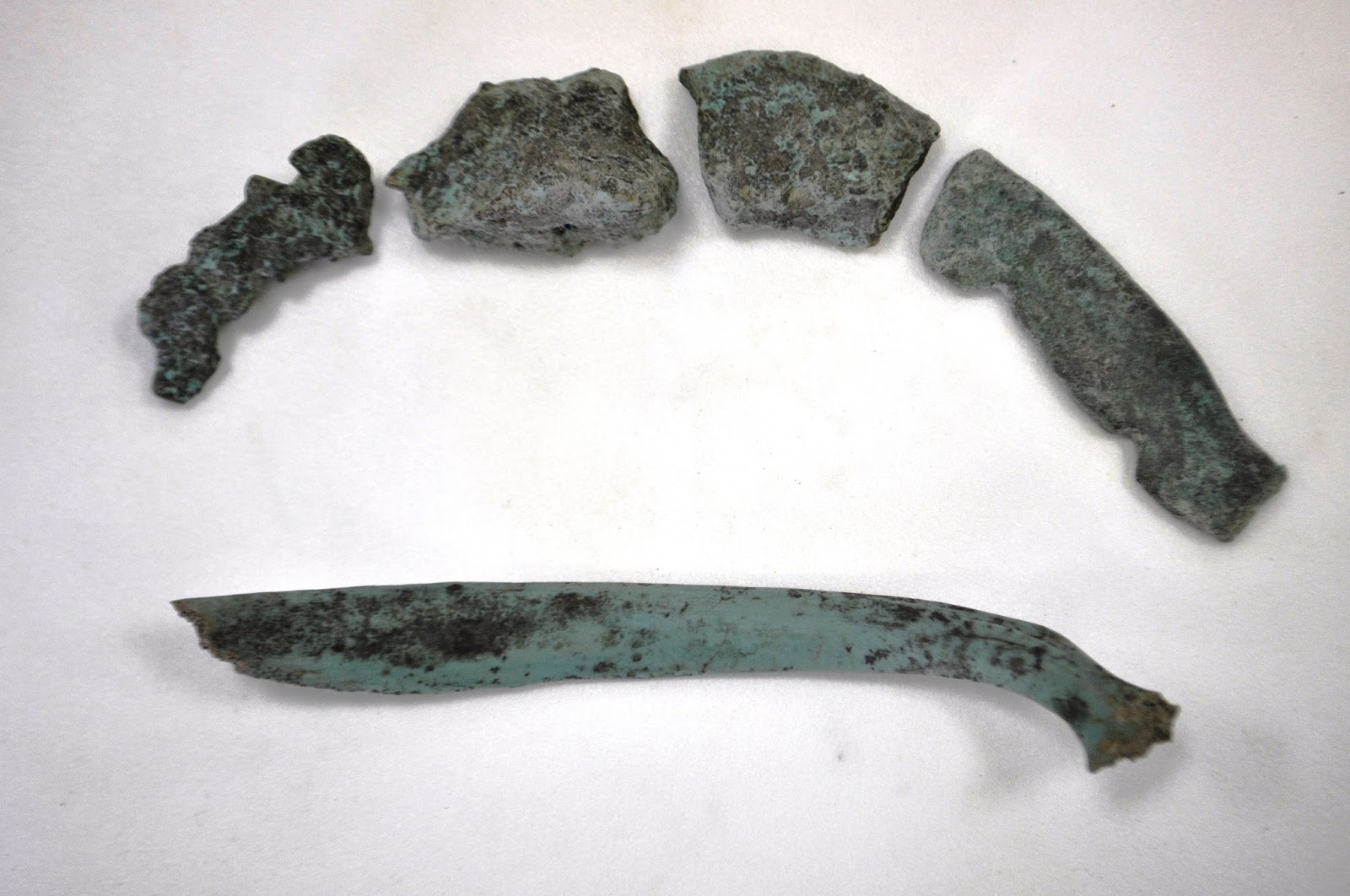
A cluster of small finds was excavated recently, including some bronze fragments and a green bone. In order to further investigate the possible relationship between these objects, Kaman Kalehöyük conservators sought the expertise of Cheryl Anderson, a PhD student in anthropology at the University of Nevada Las Vegas. Cheryl began by explaining how human bones differ from other mammals and concluded that the bone was a rib of a medium size mammal like a goat or a dog. 


Buried bone often takes on the color of the surrounding soil; conservators are able to elaborate on the scientific aspects of this particular phenomenon. The green color of many excavated metals can be attributed to copper corrosion products (such as copper carbonates, copper hydroxides, copper sulfates, etc.), which form on the surface as copper alloys deteriorate.  Many of these minerals are excellent colorants and certain compounds, like malachite (Cu2CO3(OH)2), have been used as green pigments in paints from ancient times. Because it was buried near these bronze fragments, the bone was stained by the green corrosion products as the copper alloys deteriorated.

Monday, July 29, 2013

Obsidian at Kaman-Kalehöyük


Obsidian is natural glass that forms when volcanic lava with high silica content cools rapidly. Although it only occurs at specific sites, obsidian was valued by ancient civilizations for its various properties – translucency, sharpness, workability. The obsidian from each volcanic site exhibits a unique assemblage of trace elements, which allows scientists and archaeologists to pinpoint the original source of excavated obsidian through instrumental analysis. Determining where materials originate from helps researchers understand ancient trade routes. Most of the obsidian analyzed from Kaman-Kalehöyük comes from Nenezi Dag, Tulce, and Komurcu sites in Central Anatolia, modern-day Turkey. See http://www.busitu.numazu-ct.ac.jp/mochizuki/english/stattk.htm

Conserving obsidian is much like conserving other archaeological glass. The surface is cleaned with ethanol or a solution of water and ethanol. While treating obsidian conservators must be careful of the sharp and delicate edges because obsidian fractures under mechanical pressure with the characteristic conchoidal pattern typical of pure silicates. 


Friday, July 19, 2013

Cleaning a lead object

Last week, a lead figurine was found and brought into the conservation lab here at Kaman-Kalehöyük to be treated. Since it had been freshly excavated, it was still covered with soil. Additionally, it had been bent and twisted at the arms and the waist, causing the figure to look as though it were reclining. Therefore, the primary goals of treatment were to clean and flatten the object.

Davina, the conservation intern, has been working to clean the figure. So far, a number of decorative details have been revealed, especially in the neck area, and areas of carved relief have become more prominent.

Most of the work has been done under an Olympus SZH10 stereomicroscope, but the conservation lab has been able to borrow a Dino-Lite Pro digital microscope from the archaeobotanist on site. This technology allows us to photograph and take video of magnified areas during treatment. Since a good deal of conservation work normally takes place under a microscope, we realized that this would be a good opportunity to show the detailed work being carried out in the conservation lab on this wonderful artifact!

This is a detail of a decorative protrusion on its left shoulder being cleaned using a bamboo skewer under the digital microscope at 30x magnification. Here, you can see how the loose dirt is being removed from the surface and gently blown away using a small air blower cleaner (similar to those used to clean camera lenses), revealing a more shaped element as well as a cleaner surface.


The next phase will be to gently flatten the figure. We are currently looking at several methods for this, including the application of a low heat in conjunction with mechanical means, and will be testing these methods on surrogate lead objects before carrying out the procedure on the goddess figure!